
Tyflological Models: a practical guide to regulations, materials and design

Francisco Piqueras
What are tactile models and why do they matter today?
Typhlological models are three-dimensional physical representations designed to be explored through touch, designed especially for people with visual impairments.
The term “typhlological” comes from Greek typhlos (blind) and logos (study), and is used to refer to everything related to education and accessibility for people with blindness or low vision. Thus, a typhlological model is not just a miniature model: It is a form of multisensory communication which allows you to experience buildings, landscapes or heritage elements through touch.
An inclusive resource with real impact
Today, talking about accessibility is no longer just a matter of legal compliance, but of justice and universal design.
The models designed for the visually impaired allow blind or visually impaired people understand the form, structure and spatial distribution of a place or architectural element. This can make a big difference to your experience in a museum, an exhibition, or even a classroom.
Furthermore, their use benefits all audiences: children, the elderly, or any curious visitor. By incorporating touch as the primary means of exploration, these models stimulate active learning, improve information retention, and enrich the cultural experience.

Uses and spaces where tactile models are integrated
Gentleness above all: the key is not to damage
Blindfolded models are not only suitable for museums or cultural centers. Their versatility allows them to be integrated into multiple contexts where tactile knowledge improves the understanding of the environment or a technical process.
One of the most common places where they are used is in inclusive museums, which aim to guarantee a complete experience for all visitors. In these cases, the models allow visitors to explore monuments, historical buildings, and cultural landscapes through touch, facilitating a richer spatial understanding than that obtained only from verbal descriptions or images.
Education, industry and heritage: fields with great potential
In the educational field, These models are a fundamental resource for students with visual impairments, whether in inclusive schools or specialized centers. They help to visualize abstract concepts, from the shape of a molecule to the structure of a solar system, including cities, bridges or power plants.
The industry It is also beginning to explore its potential. Companies in the energy, rail, and civil engineering sectors are using blindfolded models to explain complex infrastructures, machinery or production processes in guided tours or open days.
Finally, in urban or heritage spaces, These models serve as tactile orientation points suitable for all audiences. Installing a tactile model of a square, building, or historical site offers a unique educational experience for any visitor.

Key features of a well-designed model for the blind and visually impaired
Below, we present the essential elements that a model designed for the blind must have to be truly accessible and functional. Each feature addresses tactile, ergonomic, and universal accessibility criteria.
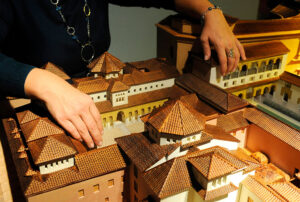
1. Scale and proportion legible to the touch
The scale must allow the user Run your hands effortlessly over the entire model.. The proportions between elements should be kept clear, avoiding excessively small miniatures or overly compressed areas.

2. Simplified design and clear readability
It is important remove unnecessary details that could hinder tactile interpretation. The shapes should be simple and recognizable, highlighting only the essential elements of the object, building, or system represented.

3. Suitable relief and safe edges
Each part of the model must have a sufficient relief to be detected by touch without difficulty, but without causing discomfort. The edges should be rounded and free of sharp edges or corners that could cause injury.
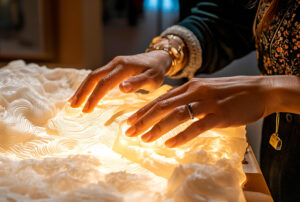
4. Durable and pleasant-to-the-touch materials
The materials should be durable, easy to clean, and comfortable to the touch. The following are recommended: technical plastics, soft woods, or well-finished 3D prints, that can withstand frequent use without losing detail.

5. Physical accessibility in its facility
The model should be placed at an appropriate height and with an inclination that facilitates exploration from different positions. It must be wheelchair accessible and not require force to interact with it.

6. Accessible supplementary information
Whenever possible, it should include Braille labels, embossed legends, or audio guides that explain what the user is touching. This information should be well organized, without cluttering the touch area.

7. Intuitive touch navigation
The design should guide the user's hands logically: from the general to the specific, allowing a smooth, confusion-free journey. This can be achieved with hierarchies of shapes, guide lines, or tactile reference points.
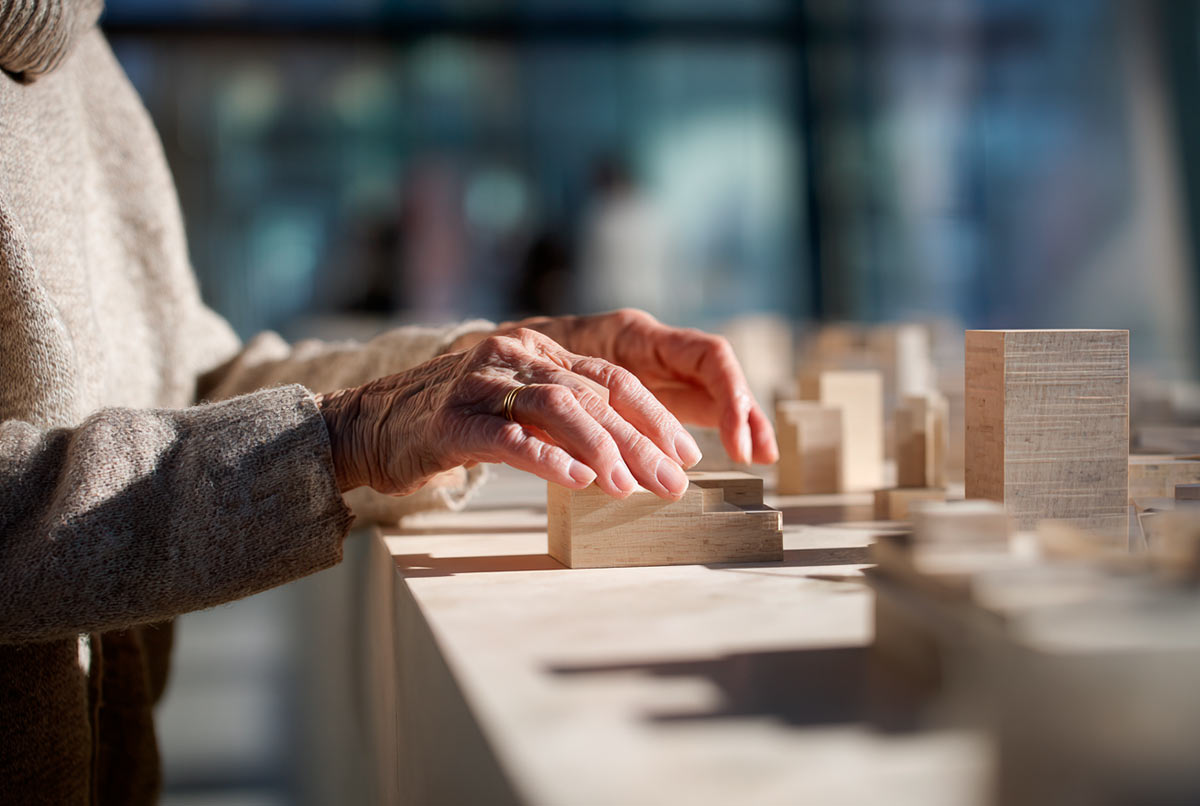
Applicable regulations and standards: ISO, EN and international guidelines
Although there is no single regulation dedicated exclusively to models for the blind, there are a number of international standards and guidelines that offer fundamental criteria for its design and manufacture. These references are key to ensuring that the model is truly accessible, safe, and understandable for people with visual impairments.
ISO 24508:2019 – Accessible design of tactile symbols
This standard defines what the tactile symbols and embossed characters so that they are legible to people with visual impairments. Although it focuses on signage, its principles are fully applicable to labels and informational elements of a tactile model.
ISO 19028:2016 – Accessible tactile maps
It regulates the content, arrangement, and methods of representation of touch maps, This is very useful when applying these principles to 3D models. It includes recommendations on scale, textures, contrast, and the model's placement in physical space.
EN 17210:2021 – Accessibility in the built environment
European standard that establishes the functional accessibility requirements for buildings, furniture and facilities. Although it is focused on the physical environment, its guidelines on heights, approach spaces and universal design They apply directly to the installation of models for the visually impaired.
Smithsonian Guidelines – Accessible Exhibition Design
These guidelines are an international benchmark in inclusive museography. They recommend that models or reproductions be accessible by touch, well positioned, and have supplementary informational materials, such as braille or audio.
In-Visible Guidelines – Accessible 3D Models
This technical document, prepared by the University of Bologna, proposes practical criteria for the manufacture of accessible 3D models, including materials, reliefs, proportions, and tactile ergonomics. It is a very valuable resource for designers and manufacturers.
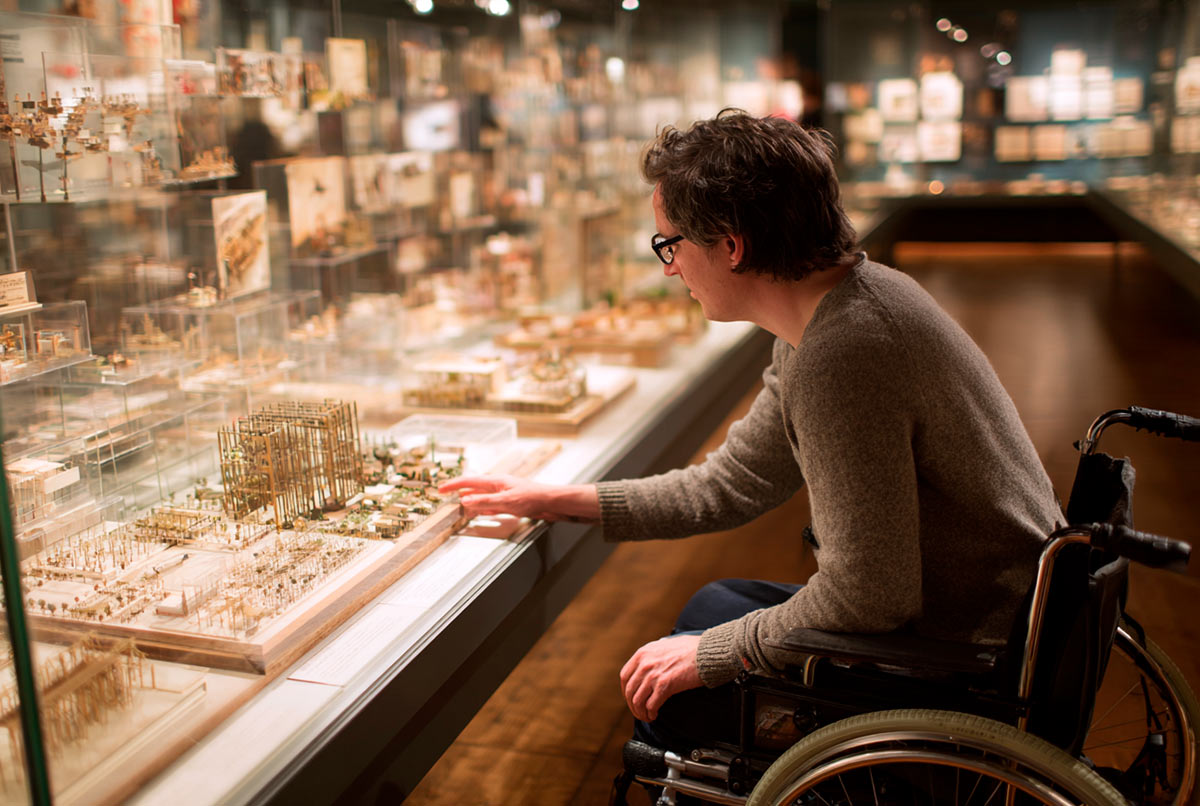
Furniture as an essential part of the blindness experience
The furniture on which a model is displayed must also meet inclusion criteria, because it is an active part of the user experience. A poor installation can turn a good design into yet another barrier.
One of the most important aspects is the stand height, which must allow exploration for both standing and wheelchair users. European and museum guidelines recommend a height between 75 and 90 centimeters from the ground, with a possible tilt of between 15° and 30° to facilitate tactile reading without straining the user's posture. This tilt not only improves access but also helps maintain a clear orientation of the model for any user.
Accessible and safe design from all angles
In addition to height, it is essential that the furniture allows for comfortable frontal approach, with enough free space for the user to stand in front of the model without restrictions. This implies leaving an area of at least 70 cm deep and 80 cm wide, which makes it easier for people with reduced mobility or with a guide cane to use it.
Regarding the materials, they must be safe, durable and pleasant to the touch. Sharp edges, unstable surfaces, or flimsy structures should be avoided. It is also recommended that the furniture incorporate supplementary informational elements, such as Braille panels, embossed pictograms, or sensor-activated audio systems. The entire system must be designed to offer an accessible, autonomous, and comfortable experience, from the first touch to the end of the touch journey.

The complexity of creating models for the blind: a job for specialists
Developing a model for the blind is a challenge that combines technical design, creativity and in-depth knowledge of accessibility. It is not enough to reproduce an object or space in miniature: forms must be simplified without losing essential information, durable and safe materials must be chosen, and ergonomic criteria must be applied so that anyone can explore it comfortably.
For this reason, having a specialized team makes all the difference. At IA Manufacturing, we put our experience at the service of projects that seek to pave the way for inclusion.
Put yourself in the hands of professionals
If you are considering incorporating tactile models into your space, or want to resolve any queries about design and regulations, Write to us. We'd be happy to advise you and help you shape your ideas.

Did you enjoy this article?
Want to see other similar posts?

