
Scale models of fire stations: the history of Alcalá de Henares told to scale

An exhibition project with a memory
The models of fire stations The murals created for Alcalá de Henares originated from a commission with strong commemorative value. The project was conceived within the framework of the park's 50th anniversary and transforms three distinct buildings into a single visual narrative, capable of explaining how the service has evolved over time and how each location has left its mark on the city.
Three locations to understand the evolution of the service
The exhibition is based on a very clear idea: to explore the history of the park through the buildings that have housed it at different stages.
The former location next to Santa María la Rica, the later headquarters on Santander Street in El Val, and the current park on Ruperto Chapí Street allow for construction a highly visual historical narrative, easy to follow for the visitor and very powerful from a museographic point of view.
The park's current location is listed at the corner of Ruperto Chapí and Federico Chueca streets.
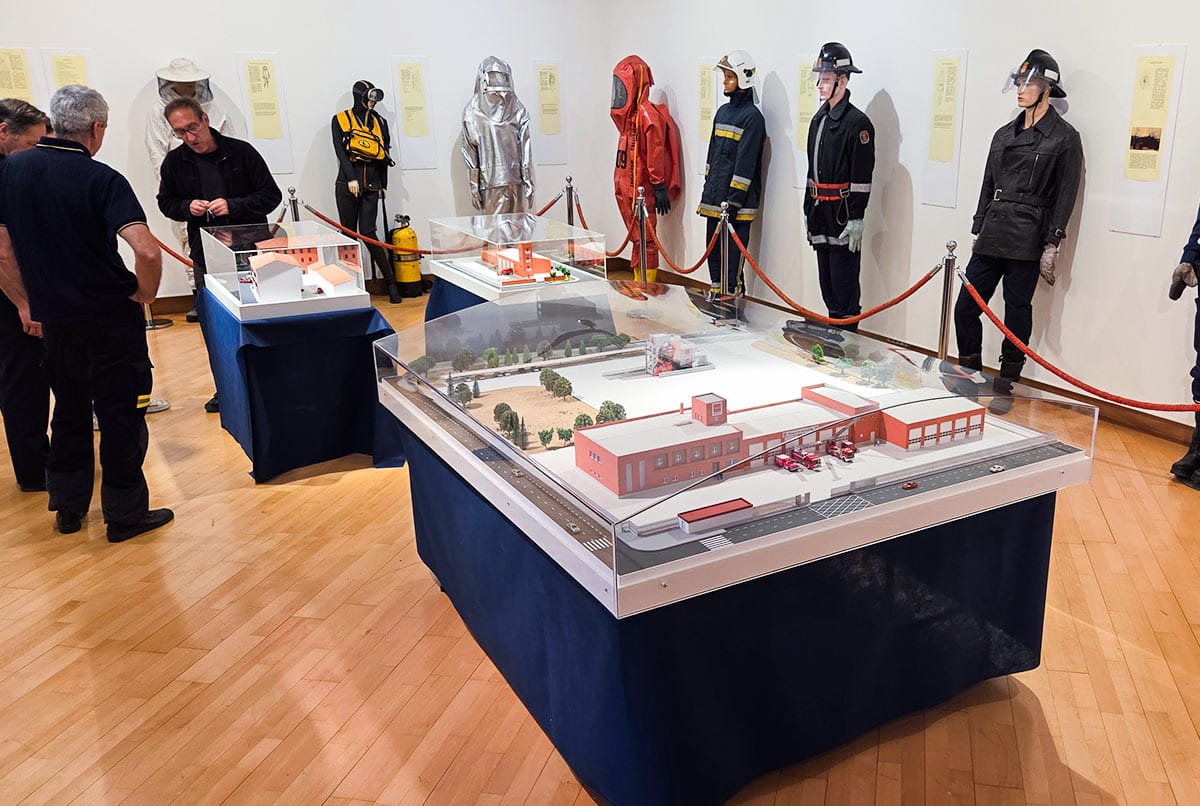
Three buildings, three moments in Alcalá
Santa María la Rica as a starting point
The first model reproduces the Santa María la Rica building on Avellaneda Street, a headquarters linked to the service's beginnings and which now has a different use within the city. This transformation gives the piece special interest because It allows the public to see that the same building can change its function over the years and still be part of the collective memory..
According to the commission, the building is currently in use by the Local Police.
Santander Street and the value of rebuilding what has disappeared
The second model has an even greater documentary weight, since it represents the headquarters on Santander Street, in the El Val neighborhood, a building that is now demolished.
Restore it in model form means giving physical presence back to a place that can no longer be visited, and that's where it appears one of the great virtues of this type of workTo make visible a recent heritage that, without rigorous reconstruction, would remain limited to memories, photographs, or preserved plans. Local and regional sources identify this site as the large park inaugurated in 1977.
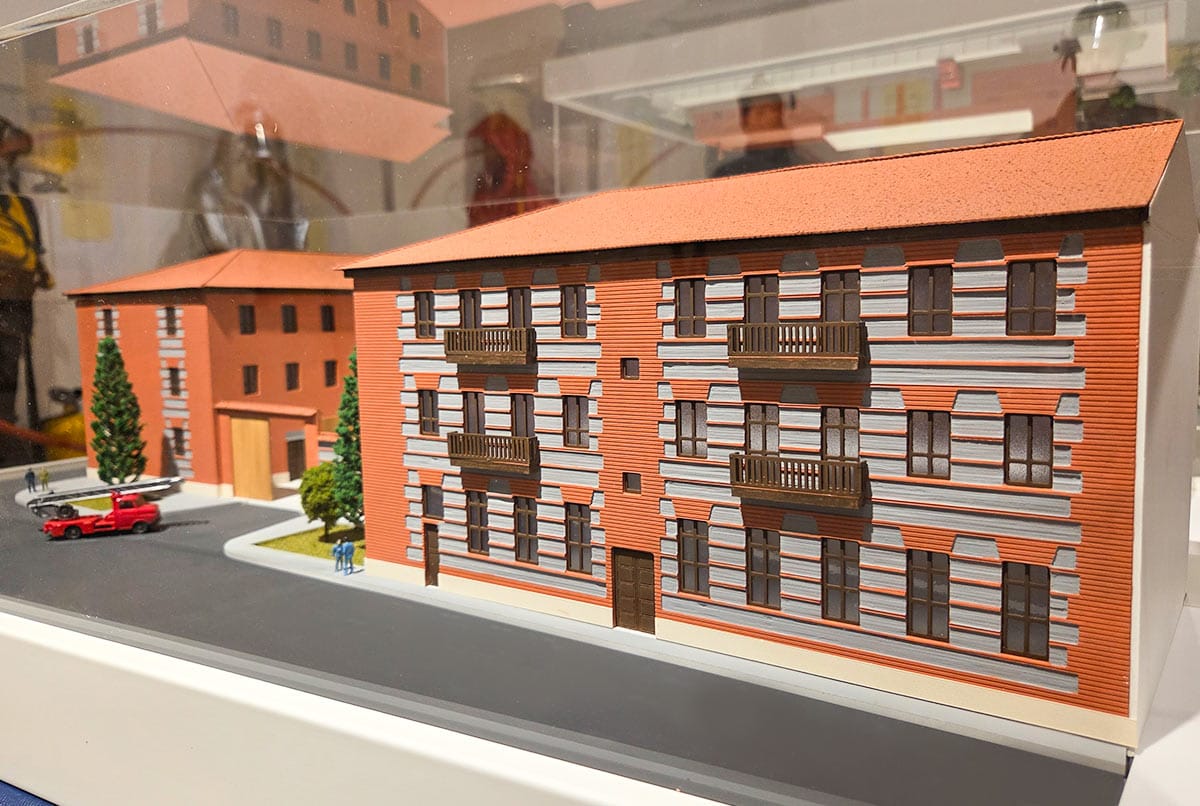
From file to mock-up
Plans, photographs and architectural reading
One of the most interesting aspects of the project is the preliminary documentation required to manufacture the pieces accurately, since we only had photographs of the historic buildings. Thanks to the additional documentation provided by the fire department—plans and photographs of the three buildings—we were able to interpret the volumes, access points, proportions, and unique features of each location.
In a historical model, the quality of the result It depends largely on that analysis phase.
Translate the technical information into a clear piece
When we work on these kinds of projects, it's not just about copying a facade or reproducing an outline. We have to decide what level of detail helps to better understand the building, which elements should be more prominent, and how to balance technical accuracy with expository clarity.
In this case, the models of fire stations They had to respond both to a documentary need and to an informative function, so that each piece had to be both precise and legible to any visitor.
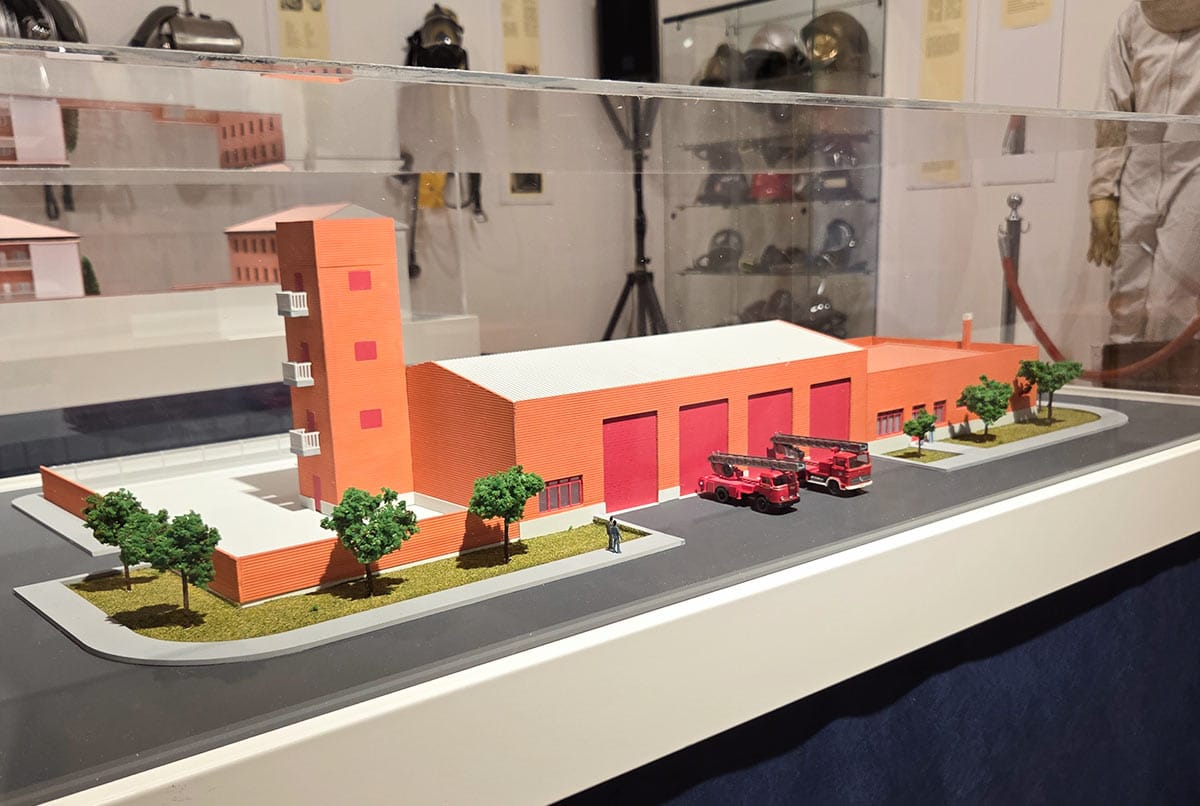
Scale as an exhibition tool
The commission specifies a scale of 1:100 for the three models, a very wise choice when seeking to combine architectural definition with exhibition presence. This scale allows for a clear understanding of the overall configuration of each building, a good reading of its proportions, and a size that works very well in a gallery space, especially in an exhibition with several pieces that need to interact with each other.
Dimensions that reinforce the presence of each piece
The approximate measurements of the project also show that we are not dealing with minor reproductions, but with pieces with a real presence within the exhibition space.
The scale model of Avellaneda Street measures 75 x 45 cm, that of Santander Street 96 x 57 cm, and that of Ruperto Chapí 148 x 182 cm. This format helps visitors perceive each location as its own chapter within the historical journey proposed by the exhibition.
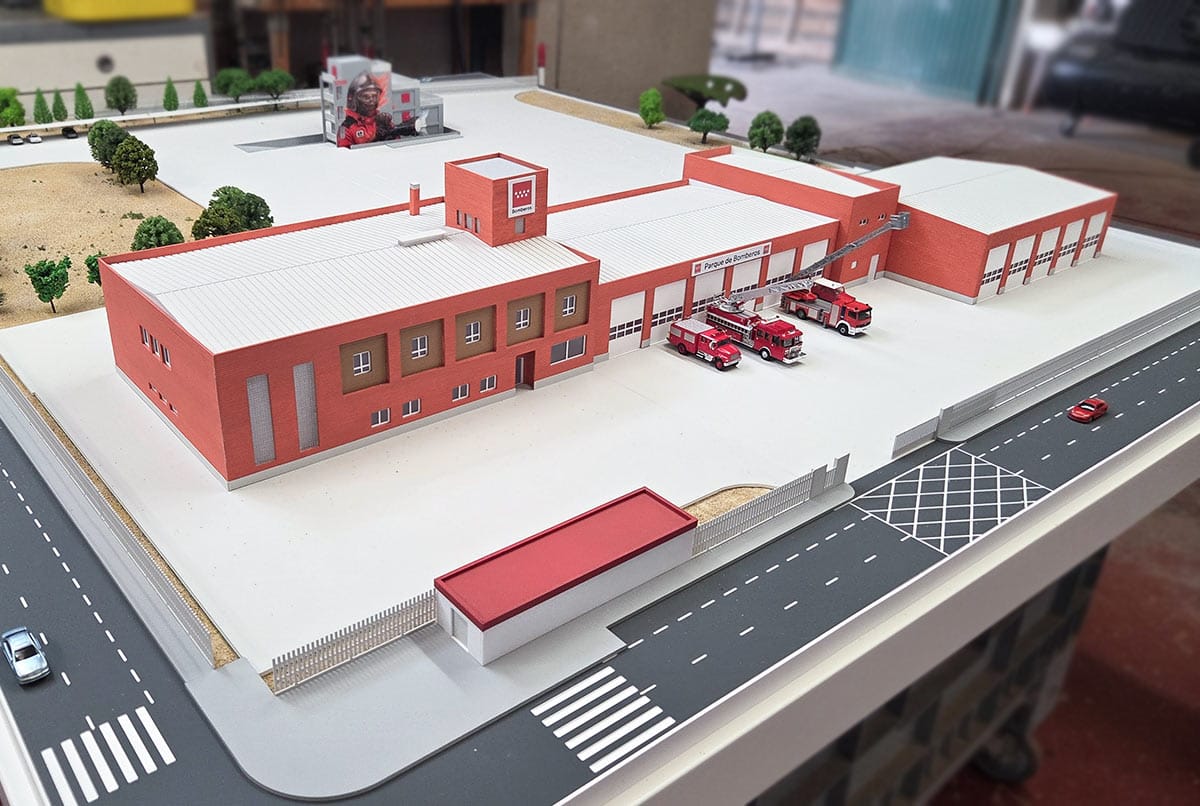
Models of fire stations with museum value
The most valuable aspect of this project is that it demonstrates how fire station models can function as a cultural tool and not just as an object of architectural representation.
In a commemoration like the 50th anniversary, these pieces help to explain the growth of the service, its changes of location, and the relationship between the firefighters and the city., All of this is achieved through a direct and approachable visual language.. The official anniversary celebration included educational events focused precisely on the history of the park.
A way of making visible what can no longer be traveled
Some projects have obvious technical value, while others also preserve memory. This one belongs to the latter category. Reproducing in a single exhibition a building that has changed its use, another that has disappeared, and the current fire station allows for the construction of a complete, coherent, and very human narrative about the history of the fire department in Alcalá de Henares.
And that's where the strength of these pieces lies: turning architecture into shared memory.

Did you enjoy this article?
Want to see other similar posts?

