
This is how a kinetic sculpture with 800 birds in flight was made

The fabrication of a kinetic sculpture for the House of the Imperial Eagle of Pedraza It arose from a very specific intention: to intervene in the void between two floors of the museum with a piece capable of activating the space and generating an immersive visual experience.
From the beginning we understood that It wasn't simply a matter of filling an architectural gap, but of making it an essential part of the route.. The sculpture had to integrate naturally into the building and, at the same time, introduce a presence strong enough to transform the visitor's perception when looking up or down.
A place where architecture, content, and movement intertwine.
The piece was conceived as a large, suspended flock, designed to complement the verticality of the space and reinforce the continuity between the museum's two levels. This decision allowed the void to be treated not as an absence, but as a space for interaction between architecture, content, and movement. The intervention had to feel alive from the first glance., as if the space were being traversed by a scene in mid-flight.
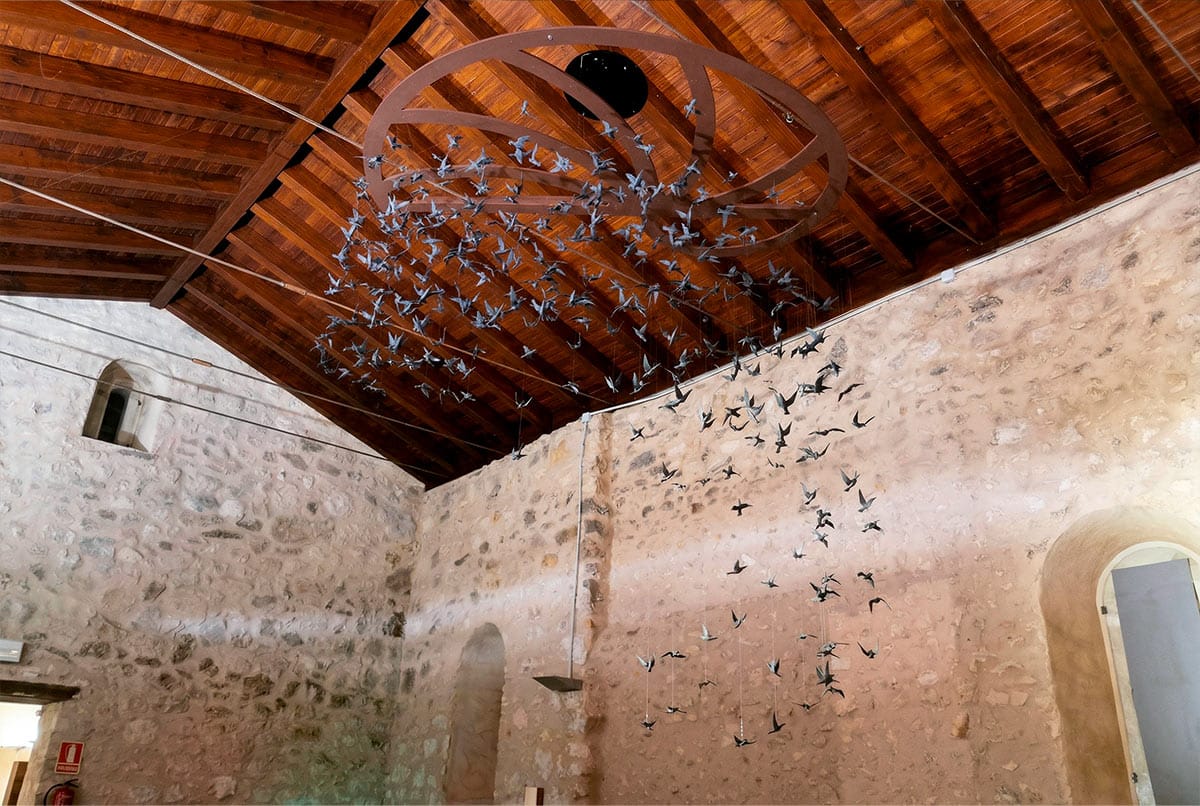
An aerial flock designed to connect the two plants
The sculpture was designed with a diameter of 2.5 meters and a total height of 4 meters, proportions that allowed the piece to have a strong presence without sacrificing lightness. These dimensions were crucial for the installation to maintain a clear presence within the building and for the whole to be perceived from different points without disrupting the harmony of the space.
The scale was not only a formal matter, but also a response to the need for the composition to complement the central void with balance and continuity.
An orderly and natural flight
The main idea was to give the impression that the flock was descending between the two floors of the museum. Therefore, the piece was arranged so that the visitor perceives a continuous trajectory, almost as if the birds were crossing the interior of the building in an orderly and natural flight.
That vertical reading transforms a passing point into a moment of more leisurely observation. The void thus goes from being a neutral space to becoming one of the most suggestive focal points of the visit.
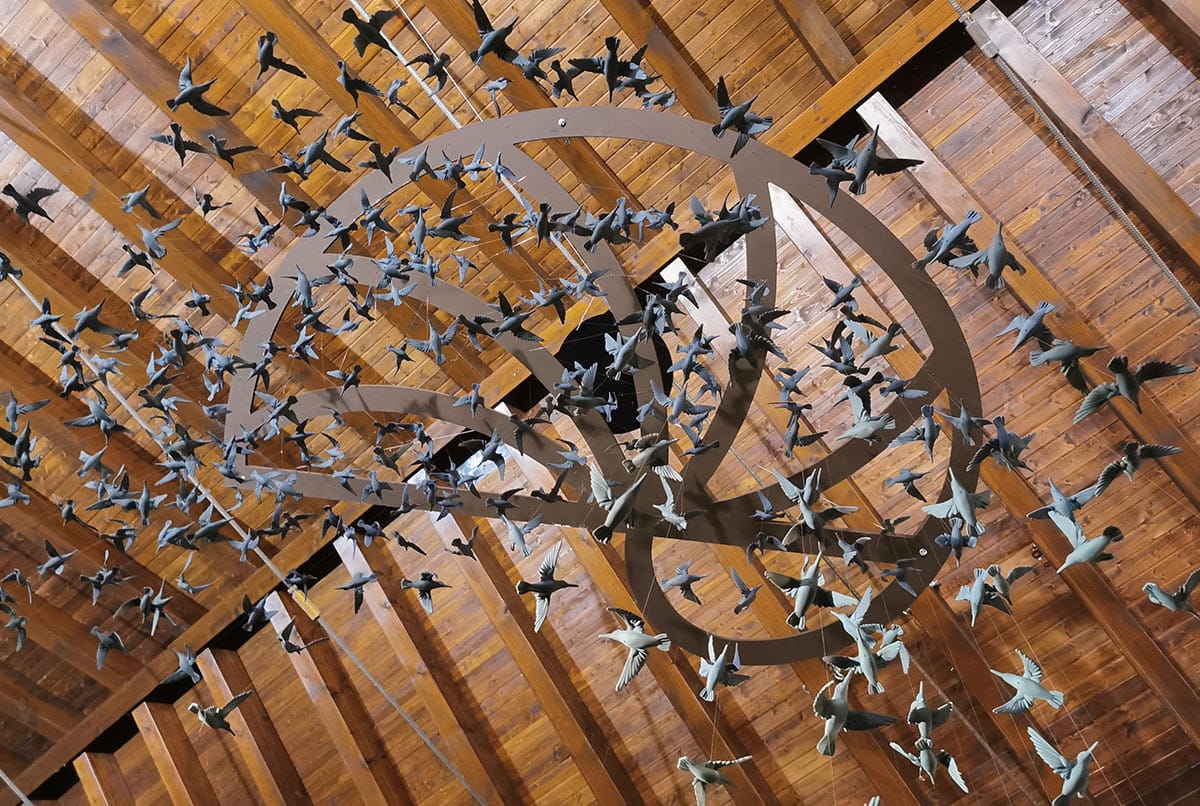
Fabrication of a kinetic sculpture to activate the visitor's gaze
In this project, the sculpture had a clearly expository function. It was not conceived as an isolated object, but as a piece capable of guiding the viewer's gaze and enriching the visitor's experience. Installed at the top of the museum and extending downwards, its presence establishes an immediate visual connection between the building's two levels.
The visitor does not discover it all at once, but rather reads it as they change position, which reinforces the feeling of depth and adds interest to the space.
A movement suggested through form and arrangement
The sensation of movement didn't depend on a mechanism, but rather on the way the piece was visually constructed. The entire composition was designed to suggest a continuous trajectory, with a spiral arrangement that reinforces the impression of descent and creates a natural path for the eye.
EThe eye does not stop at a single point, but moves around the whole following a sequence that provides rhythm and continuity. That way of reading the piece was fundamental for the flock to feel dynamic.
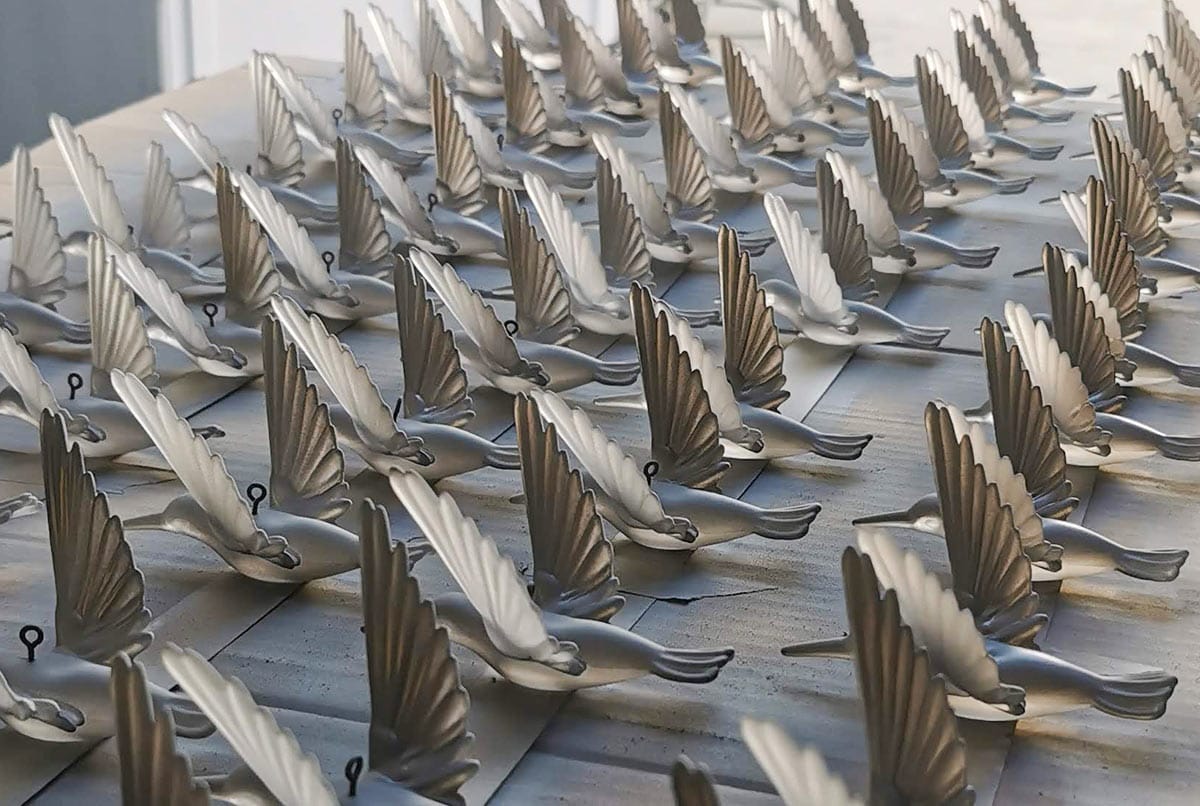
Modeling of 800 birds with a variety of flight positions
One of the most complex aspects of the project was developing the 800 birds that make up the flock. For the whole to be believable, it wasn't possible to systematically repeat the same figure.
It was necessary to model different flight positions, by introducing variations in wing spread, body tilt, and the orientation of each bird. This diversity allowed the composition to have a natural feel and avoided an overly standardized appearance.
Fabrication of a kinetic sculpture from hundreds of elements
The fabrication of a kinetic sculpture of this nature required very precise control of each phase of the process. Since it is an installation composed of hundreds of pieces, any decision about scale, arrangement or density affected the visual behavior of the whole.
It wasn't enough to produce all the elements separately. A constant global vision had to be maintained so that the piece would function as a unit, with rhythm, direction, and balance.
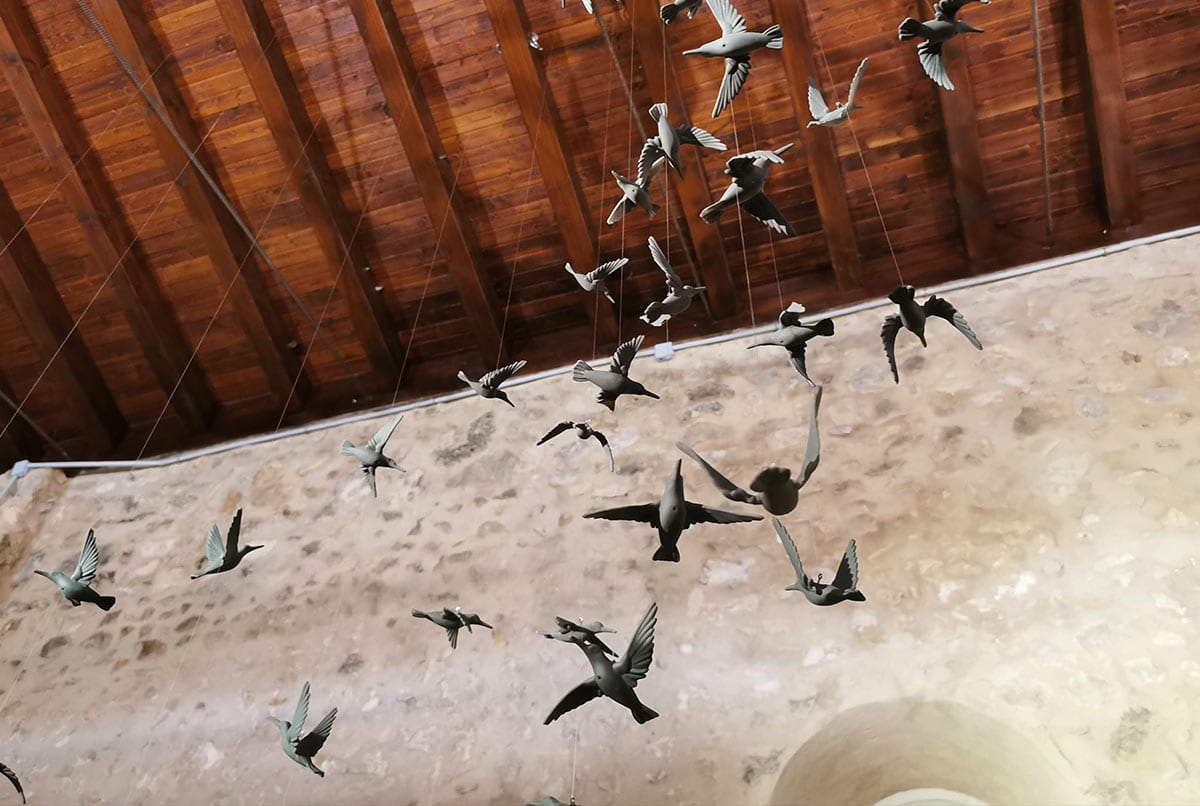
The logarithmic spiral as a support for composition
The support from which the birds hang was crafted in the shape of a logarithmic spiral, a decision that played a decisive role in the piece's identity. This geometry was chosen not only for its formal value but also for its ability to complement the project's logic.
The spiral allowed the installation to be organized in a way that was consistent with the idea of descent and helped to clearly convey the movement of the flock.. Thanks to that structure, the composition acquired a recognizable direction and a much more organic visual cadence.
A structural design at the service of the flight effect
Beyond its supporting function, this spiral had to contribute to the visual lightness of the sculpture. In a suspended work of this size, The structure cannot overpower the overall image., because any excess would break the sensation of flight. It was necessary to organize the composition and support each point of suspension without detracting from the birds' prominence.
This discretion was essential for the piece to maintain its evocative power and for the visitor to perceive the flock before the system that makes it possible.

Did you enjoy this article?
Want to see other similar posts?

