
The scale of architecture in practice, choose the best one for your models

Francisco Piqueras
The scale of architecture is essential, especially in the model making. It allows you to transform ideas into proportional and precise models. This text review its influence on the representation of architectural projects.
Choosing the correct architectural scale is crucial for accurately detailing everything from the smallest details to vast landscapes. This explains how to select and use the appropriate architectural scale for various types of models., ensuring that each one faithfully conveys the proposed design.

Definition and application of architectural scale in models
The scale of architectural models is crucial for defining the proportion between the model and its real-world equivalent. It is indispensable for designers and engineers., facilitating the evaluation of designs and the testing of structures prior to construction. Selecting the appropriate architectural scale ensures that each element of the model accurately reflects the actual size of the project.
This includes everything from minute details, such as textures and seams, to the recreation of vast landscapes or entire cities. Properly managing this ratio is vital for understand and manage space effectively, as well as to communicate the design concept clearly to all stakeholders.
A well-chosen architectural scale transforms the model into a powerful representation and clear of the project, allowing an accurate visualization of the final result.
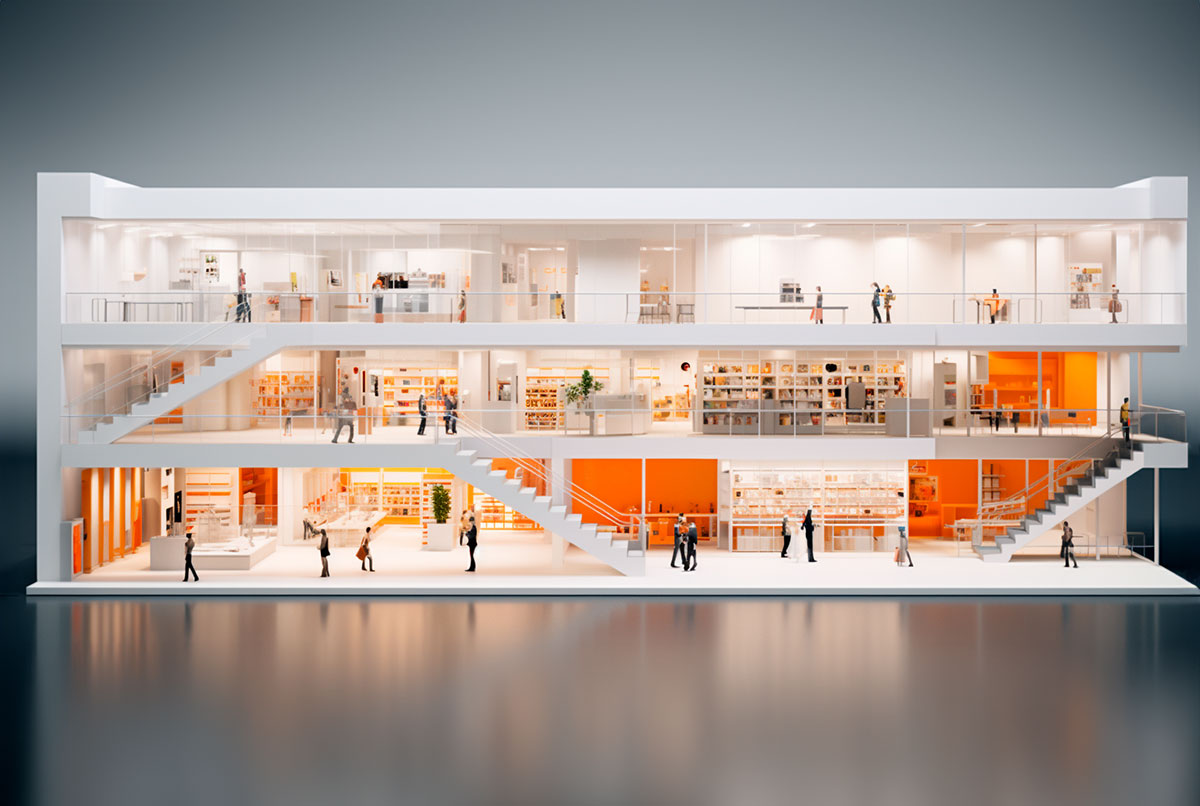
Types of architectural scales in model making
The appropriate selection of the architectural scale is crucial in architectural design, especially for the creation of models. Each type of scale opens a different window into understanding and representing the project, covering everything from the finest details to an overview of the design.

Enlargement scale
Sometimes, a clearer and more precise view of certain construction or design details is needed than what the actual size can provide. This is where scale enlargement comes into play.
Scales such as 2:1 or 5:1 magnify these specific details, giving architects and designers the opportunity to to delve into the more complex technical aspects of the design. This approach is very useful for anticipating and solving construction problems before implementation and for effectively communicating innovative solutions to construction teams or clients.

Reduction scale
Predominant in the creation of architectural models, It facilitates the representation of a complete project in a manageable format. The reduction scales vary significantly, from 1:5, ideal for interiors and furniture, to 1:50,000, for large urban developments or landscapes.
The selection of a specific reduction scale It depends on the level of detail required and the overall size of the project. Smaller scales such as 1:500 are suitable for individual projects or small complexes, while larger scales such as 1:1000 allow visualization of the interaction between multiple buildings or the composition of an entire neighborhood.

Natural scale (1:1)
Representing objects at their actual size, The natural scale is perfect for designing and examining specific components that require detailed attention. This includes custom furniture, woodwork details, or decorative elements.
Working at this scale allows designers and architects interact directly with textures, materials, and spatial relationships, supporting well-founded design decisions.

Scales of representation in architecture according to use
Model making is a crucial aspect of architecture, providing a physical and tangible representation of projects. These tools are indispensable for Explore, understand, and communicate architectural design in its various stages..
The following details the main types of models used in architecture, each with a specific purpose and application.

Detailed models
These scale models focus on the accurate representation of the structural and aesthetic aspects of a project. Using scales ranging from 1:1 to 1:20, they allow architects and designers to delve deeper into the analysis of how the different elements of the design are integrated and related.
They are particularly useful for studying the connections between materials, The construction methods and final finishes. By providing a detailed view of specific components, such as facades, joints, or decorative elements, they facilitate the identification and resolution of potential technical challenges before on-site implementation.

Conceptual models
The conceptual models, Often created in the early design phases, these sketches serve to explore and communicate the project's core idea or vision. They are not necessarily tied to a specific scale and can vary. from abstract representations to more defined models.
These models are fundamental to the creative process, allowing architects experiment with shapes, volumes, and the interaction of the project with its context. Through them, different design approaches can be evaluated and the conceptual direction of the project can be effectively presented to clients or within the design team.

Presentation mock-ups
The presentation mock-ups are crafted with a high degree of detail and finish, These models, intended to showcase the final design of the project, are typically built to scales such as 1:100 or 1:200. They combine technical precision with a refined aesthetic to capture the full essence of the design.
They are key tools during presentations to clients, investors, or competitions, where The quality of the presentation can significantly influence the perception of the project. The selection of materials, attention to detail, and the incorporation of contextual elements, such as vegetation or human figures, contribute to creating a convincing and realistic representation of the proposed design.

Study models
Before arriving at detailed or presentation models, architects often create study models. These are experimental tools that allow Explore design options, spatiality, and the relationship of the building to its surroundings..
Although they are not tied to a precise scale, they are usually representations at smaller scales, such as 1:500 or 1:1000, facilitating the manipulation and study of shapes and volumes in the context of the site.

Working models
Working models are used during the design development process to study specific aspects of the project, such as the structure, the distribution of spaces, or the integration of mechanical systems.
They are often built to scales that allow a moderate level of detail, such as 1:50 or 1:100, and They are dynamic tools that evolve as the design progresses..

Scales in architecture and their applications
Scale in architecture is fundamental to determining the perception and understanding of a project within its environment. Selecting the appropriate scale is crucial for effectively representing architectural design., varying according to the purpose of the model and the desired level of detail.
The following explains how different scales are applied in architecture.

Interior spaces and high detail
To accurately represent the construction details and the interior spaces, Detailed scales such as 1:1, 1:10, 1:20, and 1:50 are used.
These scales are essential for visualizing architectural elements clearly, allowing for a better understanding of textures, materials, and spatial relationships.

Urbanization and building plans
The scales 1:100, 1:200, and 1:250 are perfect for building and urban planning.
They provide an overview of the project, including important site details such as paths and access points. These are key to appreciating how the building integrates into its context.

Environmental models and masterplan
To encompass the broader context of a project, such as an urban development or landscape design, larger scales such as 1:500, 1:1000, and 1:2500 are used.
These scales provide a general overview, focusing on overall mass and proportion rather than minute details.

Conclusion: the importance of choosing the right scale in architectural models
Choosing the right scale is a critical aspect of creating architectural models, determining not only the accuracy and detail with which a project can be represented, but also how it will be perceived and understood by those who observe it.
A well-selected scale allows architects and designers to effectively communicate the essence and details of their projects., ensuring that the architectural vision is clearly communicated to clients, collaborators, and the general public.
This careful selection process underscores the intrinsic connection between conceptual design and its physical realization, allowing for detailed explorations of form, space, and function. Furthermore, the correct scale facilitates the identification and resolution of potential construction and design challenges, improving the quality and feasibility of the final project.
If you need help establishing the scale or level of detail of a model, Don't hesitate to write to us.

Did you enjoy this article?
Want to see other similar posts?

