
How to validate a professional mock-up before manufacturing it: key reviews and approvals

Validating a professional model isn't just about signing off on a quote. It's the moment when the client and model maker transform an idea into a clear, measurable, and manufacturable project. This involves reviewing plans, scale, level of detail, materials, colors, lighting, interaction, text, final location, and transportation.
Prior approval turns an open idea into a manufacturable decision. In the manufacture of professional models, this step reduces errors when ordering a model, avoids delays, and limits last-minute changes that can affect cost and schedule.
Validating now costs less than fixing later.
A professional model has an obvious technical aspect, but also a handcrafted part and aesthetics that should be agreed upon before cutting, machining, printing, painting, or assembling. Two models can start from similar plans and end up communicating very different things depending on the model maker's criteria, the level of simplification, the treatment of materials, or the way the environment is represented.
Therefore, before validating a professional mockup, it is advisable to review visual examples, references of finishes and style decisions. The clearer the expected outcome, the less room there will be for unnecessary interpretations.

What to check in a model review: plans, scale and detail
The technical documentation must arrive prepared for the model maker.
The mock-up review begins long before seeing materials on the table; it is not enough to send a general plan or a complete 3D model of the project. If the documentation is too large, incomplete, contains errors, or includes unnecessary information, it can lead to doubts, rework, and delivery delays.
That's why it's advisable to prepare the material exactly as the model maker needs it: with updated plans, useful dimensions, clear references, and neither too little nor too much information. That initial effort facilitates the entire manufacturing process. In industrial, urban, museum or real estate projects, well-filtered documentation helps to decide which elements should be represented, which can be simplified and which should be highlighted.
The scale defines what can be represented and what must be simplified.
Validating a professional mockup involves checking if the chosen scale It allows you to represent the desired level of detail. A pipe, a railing, a facade texture, or a sign might work very well at one scale but appear excessive, fragile, or illegible at another. At this stage, it's advisable to review which parts will have greater visual prominence and which should be interpreted more simply.
The scale not only reduces the size: it also affects how the model is read. Therefore, within the process of manufacturing a model, the approval of scale and detail must be finalized before starting production.

How to avoid misinterpretations: visual references, finishes and the model maker's criteria
Visual references reduce the margin of error
In a professional model There are many details that cannot be resolved with just a written description.. The texture of a roof, the tone of a garden area, the degree of transparency of a facade, the presence of furniture, or the way in which an industrial machine is represented can be understood in several ways.
Therefore, when validating a professional model, it is very useful to gather examples of other models, photographs, color samples, and references of finishes. The more visual references there are, the easier it will be to get closer to the expected result. They can be the model maker's own work or external examples; the important thing is that they help to solidify decisions.
The model maker's judgment also forms part of the result.
Although a professional model relies on plans, measurements, and technical documentation, The final result depends in part on the model maker's judgment.. There are representational decisions that are not always drawn: what is simplified, what is emphasized, how realism is balanced with visual clarity, or what level of detail really helps to communicate the project.
That's why it's important to choose a model maker whose style fits with the desired aesthetic. Before manufacturing, it's important to make sure we speak the same visual language. This approval of the model does not eliminate the artisanal part; it organizes it and puts it at the service of the project's objective.
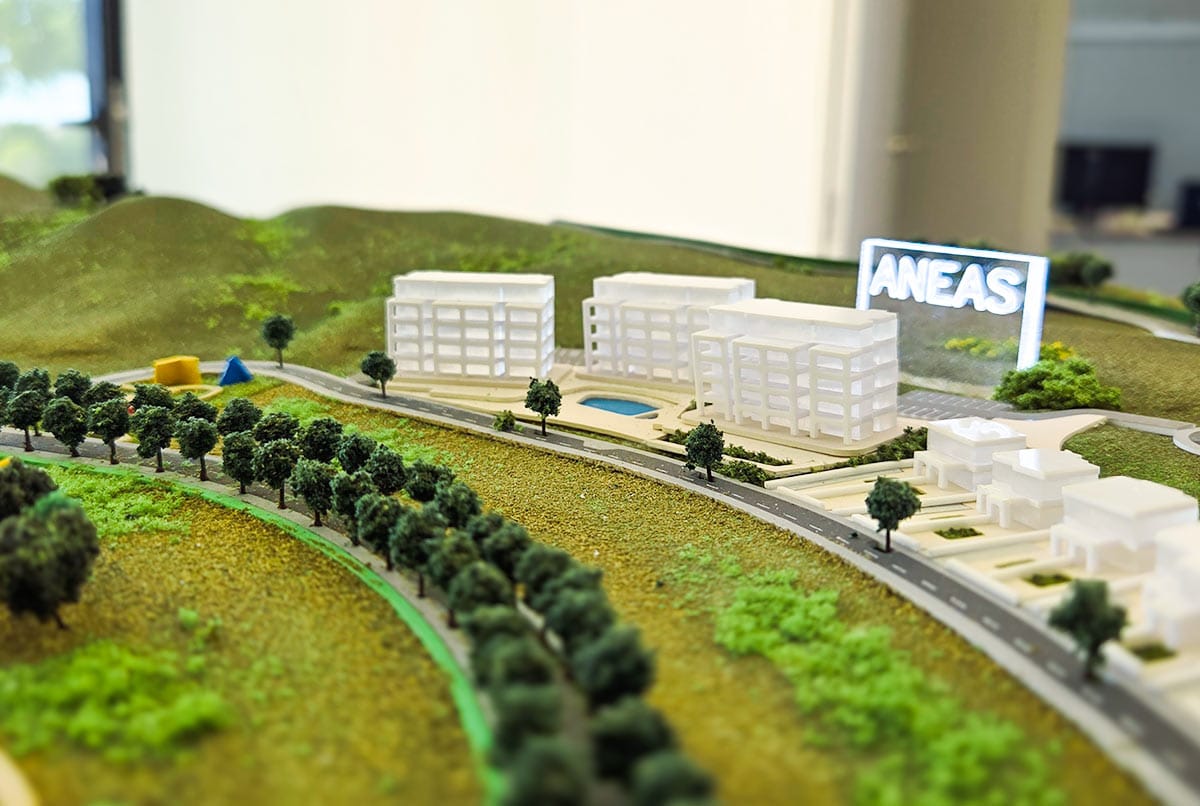
Samples, renders, and prototypes to validate a professional model
Samples, renders, and prototypes to validate a professional model
Crear a previous 3D model, textured and lit, It can be useful for validating a professional model when the project requires a very precise visual definition. It allows you to anticipate volumes, colors, transparencies, lighting, and overall composition. However, it is not always the most efficient method.
Preparing that render can take almost as long as manufacturing the model itself and represents an investment that, in many cases, is not directly used during manufacturing. The rendering helps in deciding, but it does not replace the reality of the material. Therefore, it is worth assessing whether it brings real clarity to the process or whether it only adds an intermediate phase that is difficult to make profitable.
A physical sample allows for the approval of actual finishes.
When there are doubts about materials, colors, textures, lighting or level of detail, Manufacturing a small sample is usually the most reliable option. Unlike a rendering, the sample allows you to see real finishes, tangible proportions, and light effects on final or very close to final materials.
However, it must be planned in advance. A sample can require around two weeks of work, depending on its complexity and the availability of materials. The physical sample reduces uncertainty without assuming the cost of developing a complete model. In projects with a high visual impact, this mock-up review can prevent risky decisions before going into production.
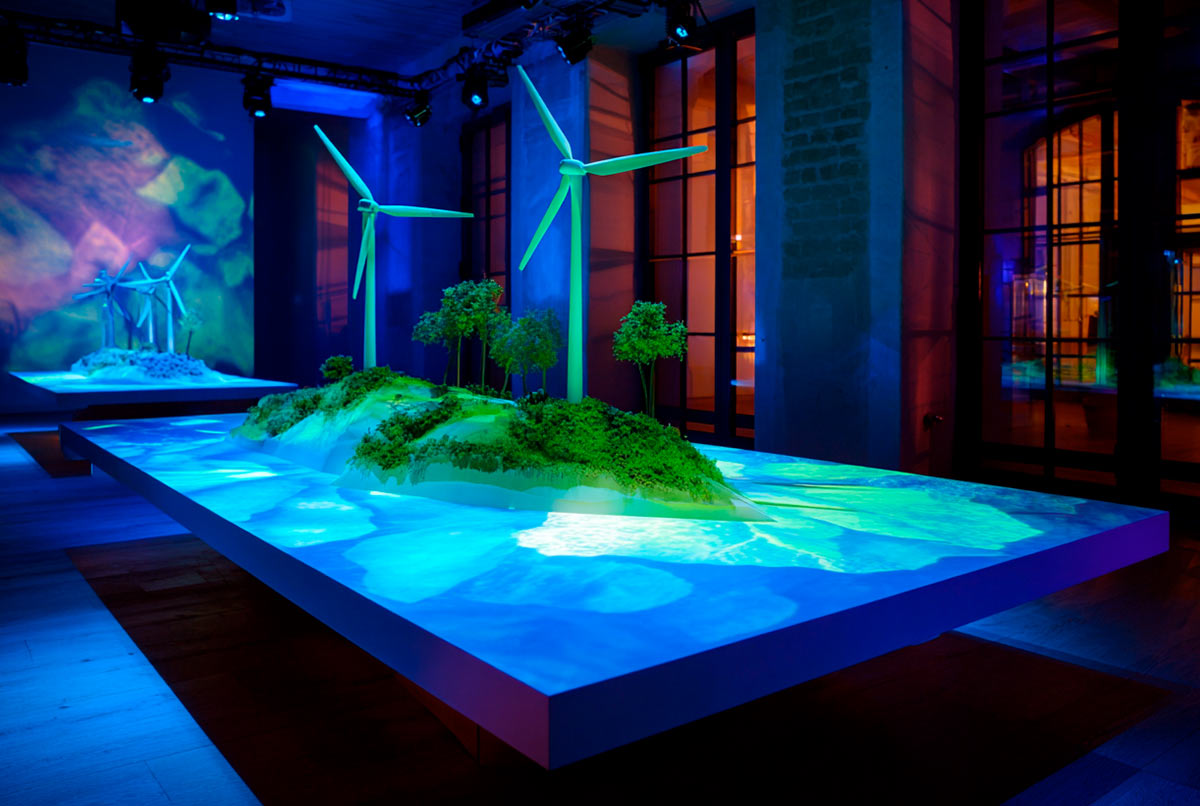
Final mock-up approval: transport, assembly and last-minute changes
The prototype must also be validated with its actual use in mind.
Before finalizing the mock-up approval, It is advisable to review where it will be installed, who will handle it, how it will be transported, and what conditions the final space will have.. A model for a meeting room is not the same as a piece for a trade fair, a museum, an institutional presentation, or a traveling exhibition.
The ballot box, base, lighting, texts, graphic elements, power supply and any interactive system must also be validated. A well-approved model is not only manufactured well: it is also installed and used better. This review avoids fragile solutions, awkward access, or decisions that complicate assembly.
Final approval should finalize decisions, not create new doubts.
Once all points have been reviewed, final approval should confirm that the model can enter the workshop with clear criteria. Changing the scale, finishes, lighting, text, or layout after manufacturing has already begun usually leads to cost overruns, delays, and less efficient solutions.
Therefore, validating a professional mockup is a way to protect the project, the schedule, and the investment. The best correction is the one that doesn't happen because it was foreseen in time. To expand on this section, we recommend also reading the article on delivery times for professional models, especially if the model has a fixed date for presentation, trade fair, inauguration or assembly.

A good revision turns the commission into a more accurate model.
Validating a professional model before manufacturing it allows for less uncertainty, better decision-making, and a shared vision of the final product. Reviewing plans, scale, finishes, materials, lighting, text, transport, and assembly is not just a formality; it's a way to avoid errors, delays, and costly changes once the model is in production.
Once the model starts being manufactured, we won't have many validation options until the different parts that make it up are assembled, so it's advisable to make sure of all possible details before starting.
The better defined the model is before entering the workshop, the more control there will be over the final result. At IA Manufacturing we help our clients organize this preliminary phase so that each professional model responds to the technical, commercial or exhibition objective of the project from the very beginning.

Did you enjoy this article?
Want to see other similar posts?

