
Technical challenges in creating machinery models

Francisco Piqueras

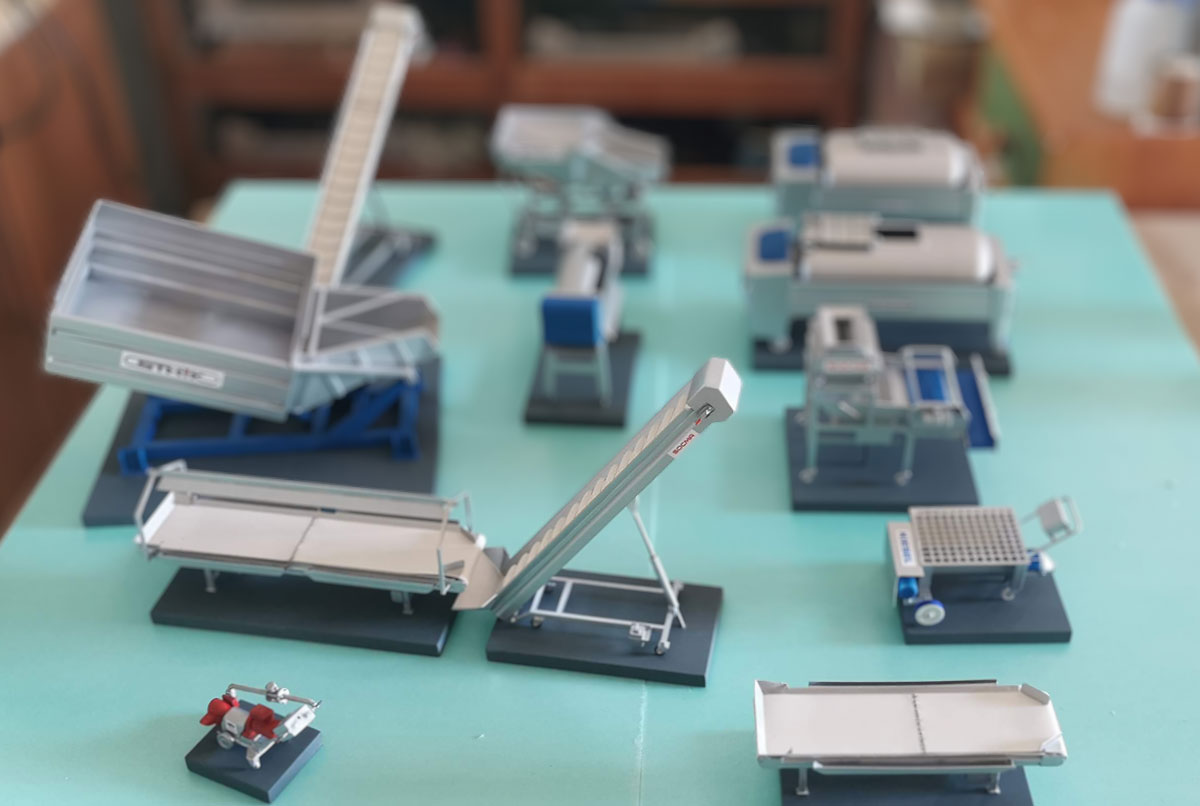
Creating scale models of food processing machinery is a task that combines art, engineering, and technical skill. This process It begins with a deep understanding of the real machines that are going to be replicated., followed by a meticulous design and planning phase.
Each model is a unique project, requiring not only an accurate visual representation, but also an interpretation that respects the laws of physics and engineering.
The resulting models not only serve as impressive visual tools, but also function as educational and demonstration pieces., providing a tangible vision of machinery that is often inaccessible in reality. This article delves into the technical aspects of this fascinating process, highlighting the skills, techniques, and decisions that bring to life these impressive machine models created for the firm. Az3oene, one of those clients with whom we feel very comfortable working.

3D Design: Visualization and Precision
In this phase, 3D modeling software is used to create digital representations of the machine mock-ups. Each model begins as a set of sketches or images, which are then transformed into detailed three-dimensional structures. The designers meticulously adjust the dimensions and tolerances to match the specifications of the actual machines.. This process involves constant review and adjustments to ensure that every detail, from screws to panels, is accurately represented.
Challenges in the design stage:
- Translation of Photographs to 3D Models: Converting two-dimensional images into detailed three-dimensional models is a complex process. It requires a deep understanding of proportions and mechanics. real machines to ensure that every detail is captured accurately.
- Technical Precision: 3D models must be not only visually accurate but also technically correct. This involves understanding the functionality of each part of the machinery to ensure that the model faithfully reflects its operation and structure.
Essential resources:
- Professional 3D Modeling Software: Use advanced software that allows for detailed modeling and realistic visualization. These programs offer tools that facilitate the creation of complex models, enabling precise adjustments and modifications.
- Collaboration with Experts: Working closely with engineers and machine designers to validate 3D models. This collaboration is essential to ensure that every aspect of the model is a faithful representation of the actual machinery.

Manufacturing Techniques: From Digital to Physical
Once the 3D design is complete, appropriate manufacturing techniques are selected to bring the models to life. This may include 3D printing, where resins or plastics are used to build the model layer by layer. In some cases, CNC machining is used for parts that require more robust materials such as metals. The choice of technique depends on the complexity of the design, the required precision, and the type of material needed. for each part of the model.
Challenges in the manufacturing stage:
- Precise Manufacturing Methods: The choice of manufacturing method is crucial. Each technique has its advantages and limitations, and the wrong choice can result in a loss of detail or accuracy.
- Handling Intricate Details: Many model kits require the reproduction of extremely small parts and fine details, which can be a significant challenge in terms of manufacturing and assembly.
Most common solutions:
- 3D Printing and CNC Machining: These technologies allow for the exact reproduction of 3D models. 3D printing is ideal for parts with complex geometries, while CNC machining is excellent for components that require stronger materials.
- Selection of Suitable Materials: Use a combination of materials that are not only easy to work with, but also offer the desired durability and finish. This may include a variety of plastics, resins, metals, and alloys.

Materials Used: Durability and Aesthetics
The selection of materials is crucial to the final result of the models. Materials are chosen that not only look realistic, but are also capable of capturing the texture and weight of the real parts. of the machinery.
Plastics and resins are commonly used for fine details and complex surfaces, while metals are used for structures and components that require greater strength. The choice of materials affects not only the model's appearance but also its functionality. durability and handling during assembly and presentation.
Main features:
- Imitation of Real Materials: Finding materials that not only look similar to those used in real machines, but also behave similarly in terms of weight and texture.
- Maneuverability in ManufacturingSome materials may be ideal in terms of appearance and durability, but difficult to work with on small scales or with fine details.
Basic materials:
- Polymers and Resins in 3D Printing: These materials are excellent for capturing fine details and can be painted or treated to mimic a variety of surfaces and textures.
- Metals and Alloys for Structural Parts: For components requiring greater strength, metals and alloys can be used. These materials not only provide durability but also a more realistic weight and feel.
Our conclusion for manufacturing machinery models
Creating scale models of food processing machinery is a field that pushes the boundaries of precision and innovation. Through meticulous 3D design, advanced manufacturing techniques, and careful material selection, It is possible to overcome these challenges and create models that are true works of technical art, combining aesthetic beauty with mechanical precision..

Did you like this model?
Want to see other interactive projects?

